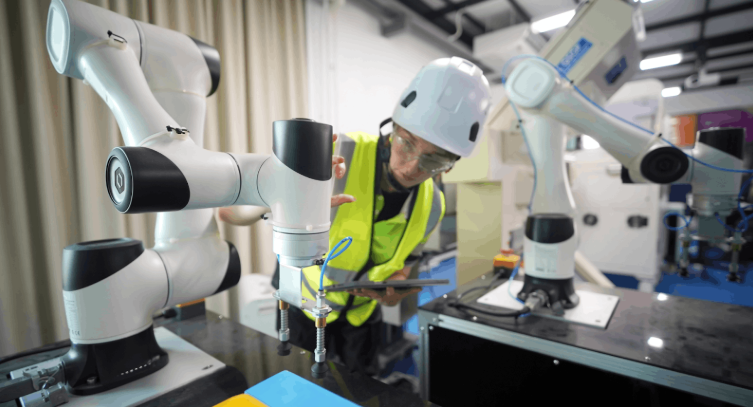
Collaborative robots, or cobots, are increasingly prevalent in industrial environments, enhancing productivity and operational flexibility. They complement human workers by taking on repetitive tasks, thereby allowing employees to concentrate on complex activities. However, the integration of cobots is not without challenges, including employee resistance and workflow disruptions. Understanding the dynamics of this technology may reveal insights into its potential impact on manufacturing efficiency and the future of work in industrial settings.
The Role of Collaborative Robots in Modern Manufacturing
Collaborative robots, often referred to as cobots, play a pivotal role in modern manufacturing by enhancing productivity and flexibility in production processes.
Their design facilitates seamless human-robot interaction, allowing workers to focus on more complex tasks while cobots efficiently handle repetitive operations.
This synergy ultimately leads to significant productivity enhancement, enabling manufacturers to adapt swiftly to changing demands and optimize their workflows.
Key Benefits of Implementing Cobots in Industrial Settings
As industries increasingly seek to enhance operational efficiency, the implementation of collaborative robots offers several key advantages in industrial settings.
Notably, cobots facilitate significant cost savings through reduced labor expenses and optimized resource allocation.
Additionally, they enable workforce augmentation by enhancing human capabilities, allowing workers to focus on more complex tasks while cobots handle repetitive functions, ultimately improving productivity and operational flexibility.
Common Applications of Collaborative Robots in Various Industries
The versatility of collaborative robots (cobots) allows them to be integrated into a wide array of industrial applications.
Common uses include packaging solutions, where cobots automate the packing process, enhancing efficiency and reducing labor costs.
Additionally, they are employed in quality inspection, providing precise, real-time analysis of products to ensure adherence to standards, thus improving overall operational reliability and product quality.
See also: Smart Tech Framework 210309893 Performance
Overcoming Challenges When Integrating Cobots Into Workflows
Integrating collaborative robots into existing workflows presents several challenges that organizations must address to fully realize the benefits of automation.
Effective integration strategies are crucial for overcoming resistance from employees and ensuring seamless collaboration between humans and cobots.
Additionally, organizations must focus on workflow optimization to enhance productivity, minimize downtime, and ensure that cobots complement rather than disrupt established processes, fostering a harmonious work environment.
Conclusion
In the rapidly evolving landscape of industrial manufacturing, collaborative robots stand as titans of productivity, revolutionizing workflows with unparalleled efficiency. They seamlessly blend human ingenuity with robotic precision, transforming mundane tasks into symphonies of automation. As cobots ascend to their rightful place in factories, they not only diminish labor costs but also elevate product quality to astronomical heights. Embracing these technological marvels heralds an era where human-robot collaboration transcends mere cooperation, forging a future of limitless operational potential.