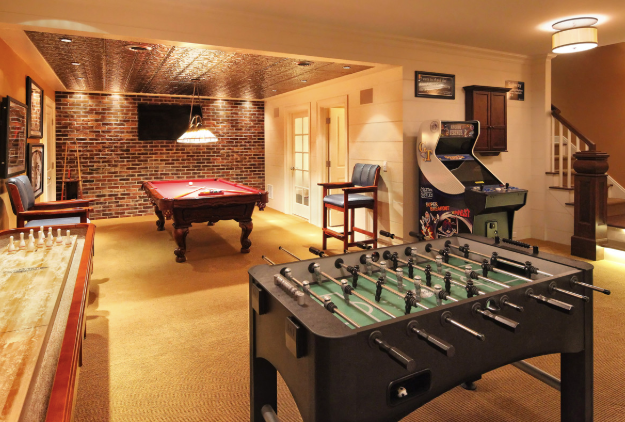
Basement game rooms benefit from clear zoning and flexible furnishings. The layout should separate entertainment, play, and seating while preserving sightlines and open space. Multi-use pieces—sofas that act as room dividers, storage that doubles as seating, desks that convert to game stations—maximize versatility. Plan modular wiring and hidden panels for easy reconfiguration, and layer lighting with acoustic control to support media and play. The next step reveals how to balance these elements within a budget.
Optimize Layout Flow for Basement Rec Rooms
Effective layout flow in basement rec rooms centers on clear zoning and unobstructed sightlines. A disciplined arrangement minimizes clutter, guiding movement with purpose. Circulation should prioritize efficient transitions between entertainment, play, and seating zones, reducing bottlenecks. Consider traffic patterns to preserve open space.
Layout flow supports freedom by enabling spontaneous activity without compromising safety or visual coherence, optimizing basement traffic efficiency.
Zone, Furnish, and Flex: Multi-Use Spaces
A well-planned basement benefits from deliberate zoning that supports multiple activities within the same footprint.
Zone planning informs layout decisions, enabling distinct areas without redundancy.
Multi use furniture adapts to shifting needs—sofas become partitions, storage doubles as seating, and desks flex into game stations.
Margins stay clean, circulation clear, and every square foot serves both function and freedom.
Flexibility endures.
Lighting, Color, and Acoustic Cinesystems
Lighting, color, and acoustic systems define atmosphere and function in a basement game room: strategic lighting layers create depth and focus, color palettes establish mood and contrast, and acoustics control sound to support both play and media viewing.
Lighting psychology informs fixture choices; color temperature shapes perception, clarity, and comfort, while calibrated acoustics sustain immersion, flexibility, and freedom in use.
Budget-Friendly Wiring, Storage, and Accessory Upgrades
Budget-friendly wiring, storage, and accessory upgrades focus on practical scalability and long-term versatility. The approach prioritizes modular systems, hidden routes, and accessible panels, enabling easy reconfiguration without disruption. Budget friendly choices emphasize durable, space-efficient components that reduce clutter while enabling future tech. Wiring storage strategies streamline cables, power, and media access, supporting a freer, uncluttered basement game room with enduring value.
Frequently Asked Questions
How Can I Improve Air Quality in a Basement Game Room?
The question is answered: to improve air quality in a basement game room, prioritize moisture control, install proper ventilation, and use moisture resistant furniture; ensure electrical safety, add acoustic treatment, and consider a bar renovation if needed.
What Safety Checks Are Needed for Basement Electrical Work?
Like a careful chess move, the answer outlines essential basement electrical safety checks: source of power, grounding, GFCIs, proper circuit labeling, conduit integrity, moisture barriers, panel clearance, and lockout-tagout procedures for a safe, freedom-loving workflow.
See also: AI and the Rise of Smart Automation
Which Furniture Resists Moisture and Mold in Basements?
Moisture resistant furniture and mold resistant fabrics are recommended for basements. The selection prioritizes sealed frames, vinyl or polymer surfaces, and tight-weave textiles. The approach favors durable, low-maintenance pieces that support a free, confident living space.
How Should I Plan Acoustic Treatment for Loud Games?
Acoustic treatment should start with strategic acoustic placement to control reflections, then optimize bass trap placement for low-frequency clarity. The approach remains minimalist and purposeful, balancing freedom with precision to support loud games without fatigue or muddiness.
Can I Add a Wet Bar Without Major Renovations?
Wet bar feasibility is moderate; it’s possible with minor remodels. A measured assessment suggests compact plumbing, ventilation, and electrical adjustments, with modular components. The approach respects freedom and efficiency, balancing aesthetics, cost, and disruption.
Conclusion
In the basement’s quiet glow, space unfolds with practiced restraint. Sofas form quiet arcs, screens vanish behind soft panels, and storage rises as seating’s calm backbone. Wires drift tucked away, like thoughts we’ve learned to forget, while light threads through zones, guiding footsteps with deliberate tempo. Color tempers the air, sound folds into corners, and every surface speaks of purpose over clutter. Here, function and mood meet—a room that breathes, plays, and finally rests in clear, confident balance.